
Chapel of the Trinity
LYON, 2003
MASSABIELLE
From Lourdes to a Monumental Work
A FOUNDATIONAL EXPERIENCE
On August 11, 1999, the day of the solar eclipse, GRATALOUP traveled to Lourdes. He was sixty-four years old. Continuing the spiritual quest that runs throughout his work, he followed the traditional pilgrim’s path: the water, the Grotto of Massabielle, and the religious service.
On his way home, as he listened to radio reports about the eclipse, he heard about rituals being performed that same day in India. He then decided to sprinkle himself with the water he had brought back from Lourdes. At that moment, he underwent an inner experience of extraordinary intensity.
“I had to reach the age of sixty-four before going to Lourdes for the first time—and, by a remarkable stroke of luck, on the day of the solar eclipse. I wanted to follow the pilgrim’s traditional path: water, the Grotto, and the religious service. […] While I was still driving, the sky opened and a great force of love came down upon me. When I returned, I began the Massabielle series.”
— GRATALOUP
Back in his studio, GRATALOUP began working on what would become one of his most monumental bodies of work.
Massabielle was born.
A BODY OF WORK BETWEEN PAINTING AND INSTALLATION

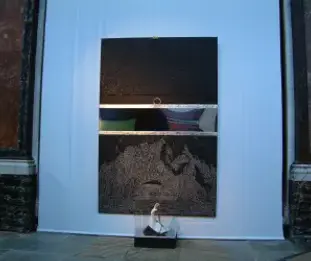

2003, Chapel of the Trinity
Massabielle is not a series of paintings in the traditional sense. GRATALOUP conceived large-scale triptych installations in which painting, materials, reflective surfaces, and three-dimensional elements extend into the surrounding space.
The cycle now comprises ten works. Nine had already been brought together for the major historical presentations of Massabielle. A tenth work, completed later and documented in the book GRATALOUP, Couleur Lumière, published in 2016, is now housed in the studio.
Each Massabielle work has its own identity, yet all are built around a shared visual language.

The Barricaded Grotto
Massabielle, Chapel of the Trinity
2003, Lyon
The lower section features the Grotto of Massabielle. From one work to another, GRATALOUP changes its colors, materials, and extensions to evoke different moments in the story of Lourdes.
At the center of the composition, a wide strip of polished stainless steel captures and reflects the light, the architecture of the venue, and the presence of the viewer. The reflection is therefore never exactly the same: the place in which the work is exhibited itself becomes part of Massabielle.
Beside this strip of stainless steel appears another essential motif: the Sun and the Moon at the moment of their encounter, a direct reference to the solar eclipse of August 11, 1999. This eclipse is woven into the very history of the cycle. It coincided with GRATALOUP’s visit to Lourdes and with the spiritual experience he identified as the origin of Massabielle.
In the upper section, thousands of signs and particles spread across the surface. They evoke the energy GRATALOUP said he had felt when, on the journey home, he sensed the sky opening and “a great force of love” descending upon him.
The two small yellow roses found at the top of several works refer to Bernadette’s description of the Lady of Massabielle: dressed in white, wearing a blue sash, and with a yellow rose on each foot.
Each work therefore brings together two moments in time:
Lourdes in 1858, with Bernadette Soubirous.
Lourdes in 1999, with GRATALOUP.
KEY MOMENTS IN THE STORY OF LOURDES
GRATALOUP did not seek to illustrate the eighteen apparitions in chronological order. Instead, he selected key moments: words, gestures, objects, and signs. A single episode could give rise to several works. Conversely, some events were condensed into a single visual composition.
In 2003, art critic Béatrice Comte described these works as “abstract and narrative,” observing that, from one work to the next, the Grotto evokes different moments in the mystery of Lourdes. This interplay between abstraction and narrative is one of the defining qualities of Massabielle.


February 25, 1858
EARTH, WATER, AND GRASS
This day marks one of the major episodes in the story of Massabielle.
GRATALOUP appears to have given it particular importance by isolating several successive moments.


FROM 1858 TO 1999
Massabielle does not simply superimpose episodes from Lourdes onto GRATALOUP’s visual world. The cycle creates a true dialogue between two experiences separated by nearly a century and a half.
In 1858, at Massabielle, Bernadette encountered a presence she was initially unable to name.
In 1999, GRATALOUP visited that same place on the day of a solar eclipse. On his journey home, he underwent an experience he described as receiving an immense force of love.
In the works, these two stories become inseparable. The Grotto belongs to Bernadette; the eclipse belongs to GRATALOUP. The reflective stainless steel brings the present—and the viewer—into the work. Past and present, narrative and experience, matter and light thus come together in each composition.
A MONUMENTAL INSTALLATION, RARELY SHOWN
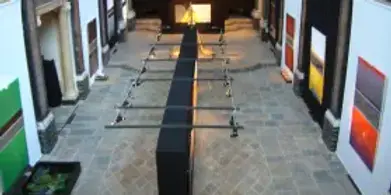
The Chapel of the Trinity in Lyon offered Massabielle the space it needed to unfold. The triptychs took their place within the architecture, while their installations extended across the floor.
The sightlines allowed several works to be viewed simultaneously, making clear that Massabielle was intended to be experienced as a spatial whole rather than as a succession of isolated paintings.

The cycle was also presented at the Saint-Louis Chapel of La Salpêtrière in Paris.
Here again, the scale of the architecture allowed the paintings, installations, and sightlines to enter into dialogue with the venue.
These two historic presentations demonstrate what Massabielle requires: an architecture capable of accommodating not only the works themselves, but also the space they create around them.
Presenting Massabielle is, in itself, a major exhibition-design undertaking. The size, weight, and number of the works, together with the installations that extend several of the triptychs into the surrounding space, make the installation process particularly demanding. The large-format works must be transported and handled, the installations reconstructed, sufficient distances maintained between the works, visitor circulation organized, and suitable lighting designed. The presence of reflective stainless steel also requires a particular dialogue with the architecture and light of the venue.
Massabielle is therefore not simply hung: it must be installed. These requirements explain why the complete cycle has so rarely been presented. They also make each presentation an exceptional event.
GRATALOUP’S WISH: LOURDES
For GRATALOUP, Massabielle was inseparable from the place where the cycle originated. He hoped one day to present the complete body of work in Lourdes and had even considered donating it so that it could remain there permanently. This project did not come to fruition during his lifetime.
This intention gives Massabielle particular resonance today: born from an experience in Lourdes, the work was also conceived by its creator as destined, one day, to return to its place of origin.
EXHIBITING MASSABIELLE
Massabielle is not a conventional touring exhibition.
Because of its monumental scale and the complexity of its installation, its presentation is intended for major institutional projects in venues capable of meeting its spatial and technical requirements.
A large religious building, an abbey, a historic monument, a heritage site, or a contemporary art institution: each new presentation must be conceived specifically in relation to the architecture of the host venue.
The rarity of its presentations is precisely one of the project’s strengths: bringing Massabielle together today means making a major body of GRATALOUP’s work, rarely accessible to the public, visible once again.
The Association Les Amis de GRATALOUP oversees the conservation and promotion of the work and supports institutions in the artistic, scholarly, exhibition-design, and technical development of a presentation project.