
GRATALOUP Art Space – Nantua
The Espace GRATALOUP in Nantua, which opened in December 2025, is dedicated to the artist’s connection with his birthplace. It is separate from the Musée GRATALOUP in Chevreuse and is neither a transfer nor a relocation of the museum.
Listen to the podcast
Text of the podcast you are listening to
Here, on this wall, spreads The Spirit of the Lake, a monumental work by Grataloup, an artist born in Nantua, in the Ain region of France. It was here, between the light of the cliffs and the depth of the lake, that he grew up, a rugged, fertile, and sensitive land that he carried within him all his life.He used to say with pride :
“You are a Catholard when you are born in Nantua.”
The word comes from cathole, a large needle once used by leather workers. He signed this mural with those very words, Grataloup the Catholard, as a way of claiming his roots, his bond with the material world.
His grandmother taught him early how to dig, to prune, to care for the vine. Those patient gestures became the gestures of painting: working the material, listening to silence, letting time do its work.
An unclassifiable painter, Grataloup mixed sand, metal, pigments, and gold leaf to create a language of light. He used to say,
“Man comes from nature and will return to nature. He must not move away from it, but learn to live with it.”
His art sought to reveal what cannot be seen, that invisible world vibrating behind all things.
“In every canvas there is a double image,” he said, “a hidden layer that the viewer receives without always knowing it.”
The Spirit of the Lake belongs to that same family of works he called The Elementals: the Spirit of Air, the Spirit of Gold, the Spirit of Night... Here, it is the Spirit of Water that speaks.
Created in 2015 from funds gathered for a planned Grataloup Foundation in Nantua, this monumental mosaic keeps that dream alive. Thousands of tesserae form the lake and its golden reflections, the limestone cliffs, and, at the centre, the symbolic figure of its spirit.
Grataloup once said,
“Just yesterday, I was standing by the lake at sunset, the sky was golden, the lake was golden. It felt like bathing in gold.There are no ugly colours, every colour is pure.”
The Spirit of the Lake is the memory of a land and a gaze, a work that unites light and matter, the visible and the invisible, and forever binds the painter to his lake — Grataloup the Catholard.
Look closely at this big wall. This is The Spirit of the Lake, a work by Grataloup. He was born here, in Nantua, between the cliffs and the lake. He used to say proudly:
“You are a Catholard when you are born in Nantua!”
A Catholard is the name for people from here. It’s an old word that comes from leather work. And Grataloup chose it to sign his mural — Grataloup the Catholard.
When he was a little boy, he helped his grandmother in the vineyards. He learned to dig, to prune, to care for the earth. Later, he did the same with his paintings : he mixed soil, sand, metal, and gold to create landscapes full of light.
He used to say that in every painting, there is a hidden image, a secret you can feel, even if you can’t see it. The Spirit of the Lake is a bit like that secret. Thousands of tiny shining pieces form the lake, the cliffs, and, right in the centre, a golden shape, the spirit of the lake itself.
Grataloup loved to stand by the water. He said:
“The sky was golden, the lake was golden. It was like bathing in gold. All colours are beautiful, because every colour is pure.”
So when you look at this artwork, imagine the lake whispering to you. It tells the story of a painter who wanted to show the hidden light of the world, and who left here, on this wall, a little bit of Nantua’s magic.
In Nantua, his hometown, the GRATALOUP Art Space was built around the monumental fresco The Spirit of the Lake, created by the artist in 2015.
The last work of urban art by GRATALOUP before his passing in 2022, this mosaic pays tribute to the light of the lake, the surrounding limestone cliffs, and his Catholard roots.
From this symbolic creation arose the GRATALOUP Art Space , a place dedicated to the painter’s memory and to his deep connection with the town where he was born.
The GRATALOUP Art Space opened its doors in early December 2025, within the Haut-Bugey Tourist Office, offering visitors a place of discovery and contemplation — a reflection of the artist himself, turned toward light, nature, and inner quest.
In this welcoming space, visitors are invited to sit and watch a rare video of the artist, or to browse a reading corner featuring monographs, catalogues, and archival materials devoted to GRATALOUP and his work.
The permanent exhibition also presents several large-scale reproductions on Dibond of major works from the Nantua series. Each piece is accompanied by immersive podcasts, available in French and English, for both adults and children — extending the sensitive and contemplative experience central to the artist’s vision.

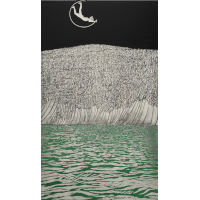


Struck Firs
A tribute to a transforming forest, where cedars are gradually replacing the fir trees
Highlights of this space include two original works gifted by Milena GRATALOUP to the City of Nantua and the Haut-Bugey Tourist Office.
The first is the original model of the lake mosaic — a piece conceived by GRATALOUP in his Chevreuse studio, in collaboration with Florence Sonsino of Ateliers Decomosa in 2014, at the inception of the public art project linking the lake to the Nantua Tourist Office.
Measuring two meters long and seventy centimeters high, this model represents the first gesture of a dialogue between art, nature, and place.
In July 2025, Milena GRATALOUP undertook a complete restoration of the model before deciding to donate it to the City of Nantua.
Now installed beside the fresco, it symbolically marks the birth of the Espace GRATALOUP, a space of memory and transmission open to visitors.


The second is a historic work, Nimbed in the Awakening of the Vegetal (1978–1985), from the Awakening of the Vegetal series, measuring 86.6 × 47.2 in.
Exhibited multiple times in France, Germany, and in various museums, Nimbus in the Awakening of the Plant Realm has now joined Nantua — in harmony with the lushness of its landscapes and the spiritual dimension that animates the town.
With the presence of the nimbus at the heart of a vegetal world, the work seems to unite nature and the sacred, as a silent celebration of the bond between earth and light.
It reflects GRATALOUP’s deep attachment to his native land and Milena’s desire to keep this legacy alive and shared.